Best Hairstyles for Round Faces
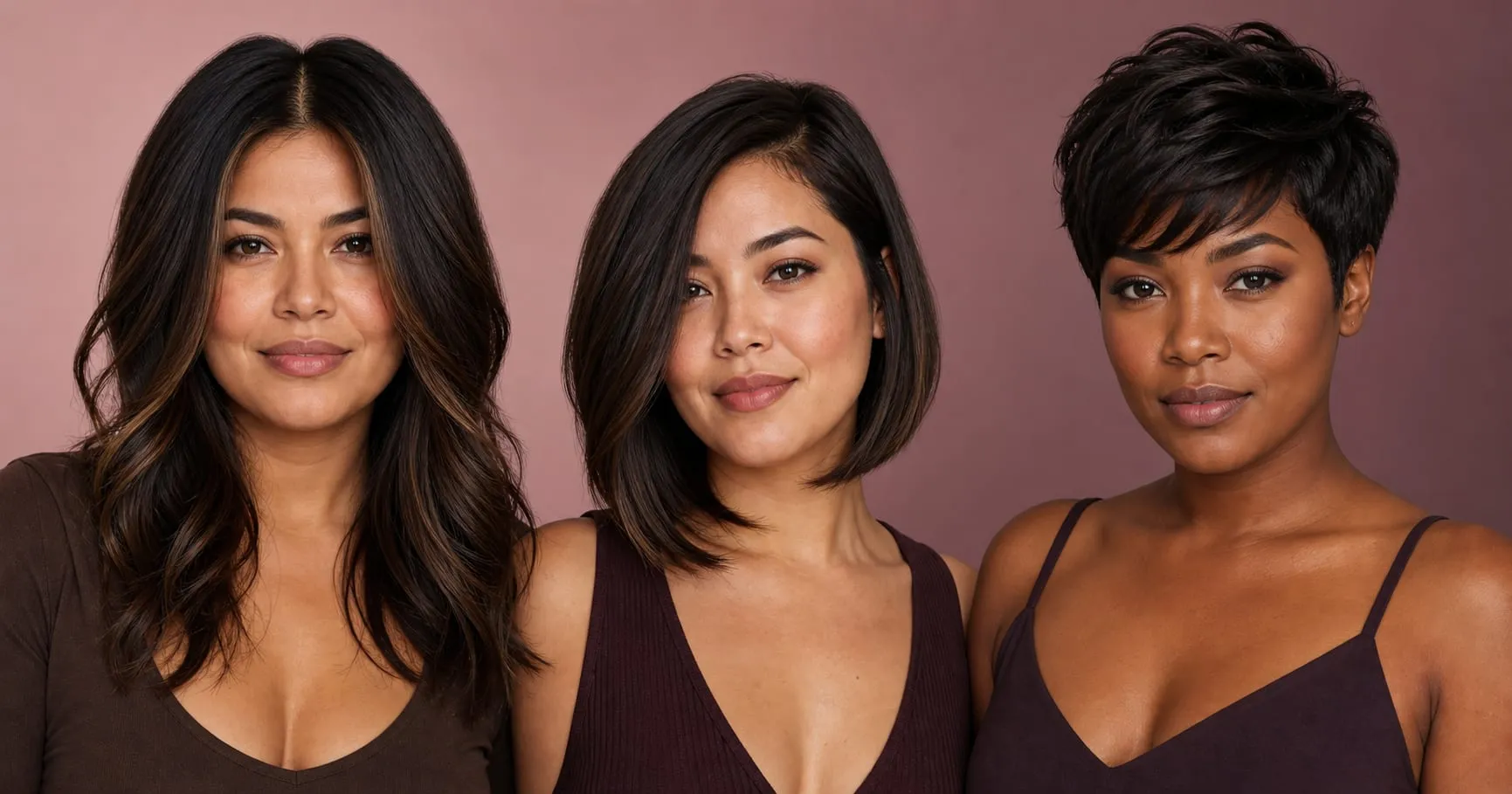
The best hairstyles for round faces create length, lift, or a diagonal line. Long face-framing layers, an angled lob, curtain bangs, a side-parted pixie, and a collarbone shag all work because they add definition without hiding your face. If you want a longer-looking silhouette, keep the shortest layers away from the fullest part of the cheeks and place volume at the crown or below the jaw instead.
That is the useful rule—not that a round face has to avoid short hair, curls, or bangs. Your texture, density, hairline, and styling routine matter just as much as face shape. Use the ideas below as a shortlist, then choose the version that works with your actual hair.
How do I know if I have a round face?
A round face is close to equal in length and width, is usually widest across the cheekbones, and has a softly curved jaw and chin. The forehead and jaw tend to be similar in width, with few sharp angles around the outline.
To check, pull your hair back and take a straight-on photo in even light. Compare the width across your cheekbones with the distance from your hairline to your chin. If those measurements are similar and the jaw is curved rather than angular, your face probably leans round.
Do not worry if you also see traits of an oval face or a square face. Most people sit between shapes. If your jaw looks straighter and more defined, compare this guide with our hairstyles for square faces. If your upper forehead is broader and your jaw tapers to a pointed chin, compare it with our hairstyles for heart-shaped faces. Our complete face-shape haircut guide explains all six common shapes, and the face-shape analysis tool can give you a starting point from a selfie.
Best hairstyles for round faces at a glance
| Hairstyle | Why it flatters a round face | Best for |
|---|---|---|
| Long face-framing layers | Creates vertical movement and keeps weight away from the cheeks | Straight, wavy, or curly hair |
| Angled lob | Longer front pieces draw the eye below the jaw | Fine to medium hair |
| Curtain bangs with long layers | Opens at the center and adds diagonal lines beside the face | Medium to long hair |
| Deep side part with waves | Adds asymmetry and lift instead of equal width | Wavy or curly hair |
| Textured pixie with crown height | Builds vertical volume and exposes the jawline | Fine to thick hair |
| Collarbone shag | Adds broken, vertical texture without a round outline | Wavy, curly, or dense hair |
| Long bob with off-center part | Length below the chin visually stretches the face | Straight or softly wavy hair |
| High ponytail or top knot | Pulls the eye upward and keeps the sides clean | Medium to long hair |
1. Long face-framing layers
Long layers are the safest all-round choice because they preserve length while removing bulky weight from the sides. Ask for the shortest face-framing pieces to begin around the cheekbones or jaw, then blend into lengths below the collarbone. The descending lines lead the eye downward and make the outline feel more elongated.
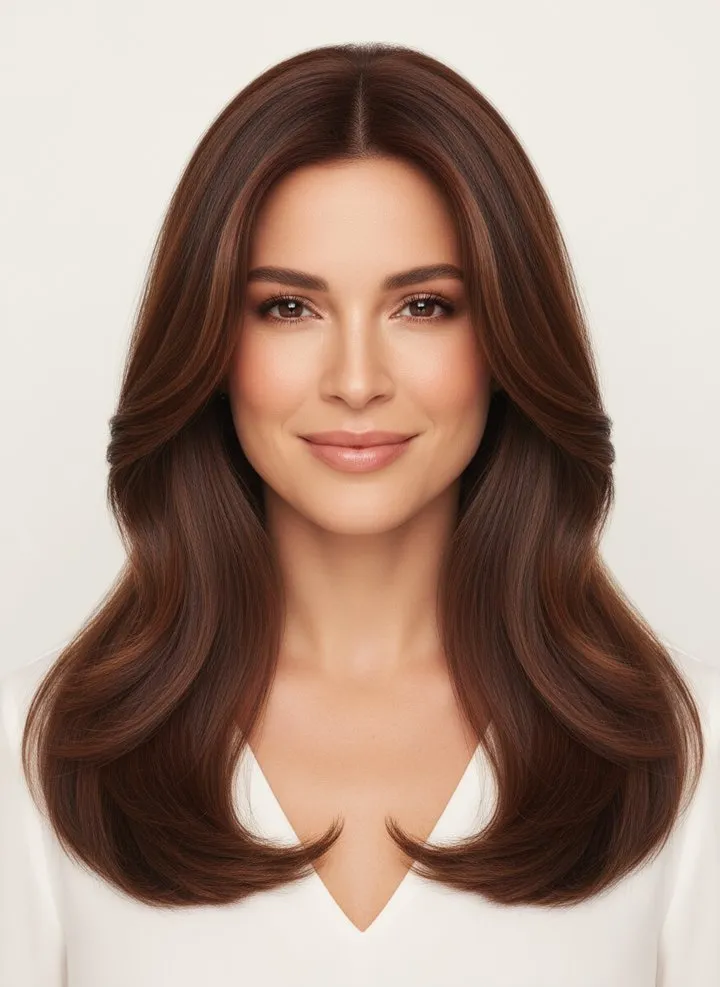
Try long face-framing layers on your face →
For straight hair, keep the ends tapered and smooth. For waves or curls, ask the stylist to cut enough graduation that the texture falls vertically rather than forming a triangle at cheek level. A center part strengthens the lengthening effect, while an off-center part gives a softer result.
2. An angled lob below the chin
An angled long bob, or lob, is shorter at the back and gradually longer toward the front. Those longer front pieces frame the jaw on a diagonal, giving a round face more structure. The most reliable length lands between the jaw and collarbone; a cut that stops at the fullest part of the cheeks can add width instead.
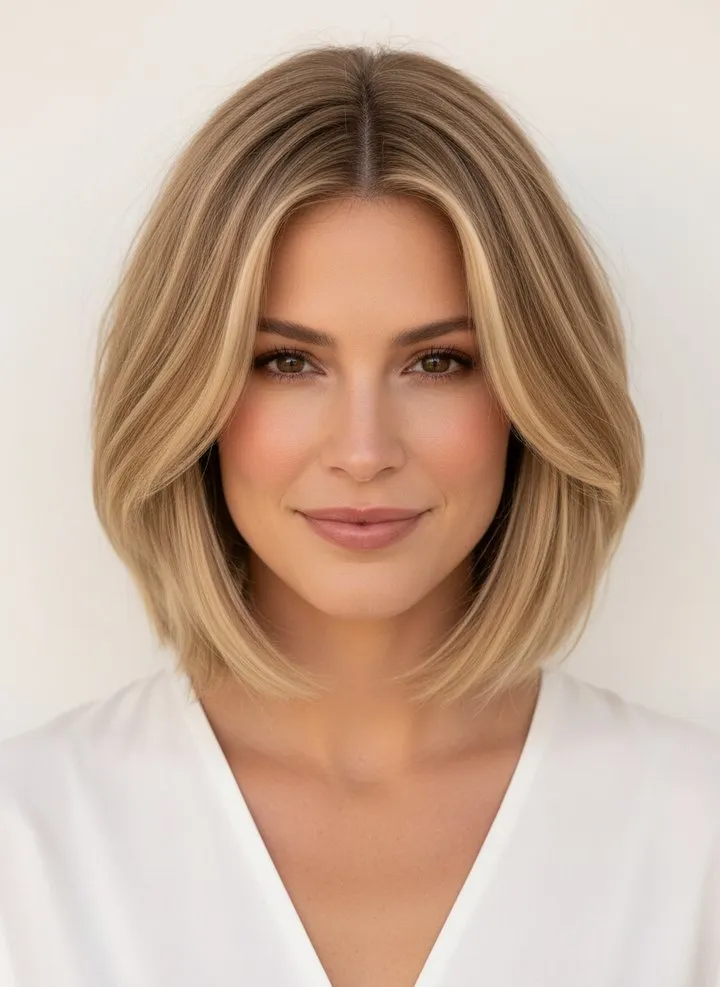
Try an angled lob on your face →
Ask for a subtle angle rather than an extreme stacked shape. Too much stacking at the back can push volume outward, while a gentle A-line keeps the silhouette sleek. A side part or slightly off-center part stops the shape from looking overly symmetrical.
3. Curtain bangs with long layers
Yes, round faces can wear bangs. Curtain bangs are especially flattering because the center opening reveals part of the forehead while the sides sweep toward the cheekbones. That split creates two diagonal lines instead of one horizontal block.
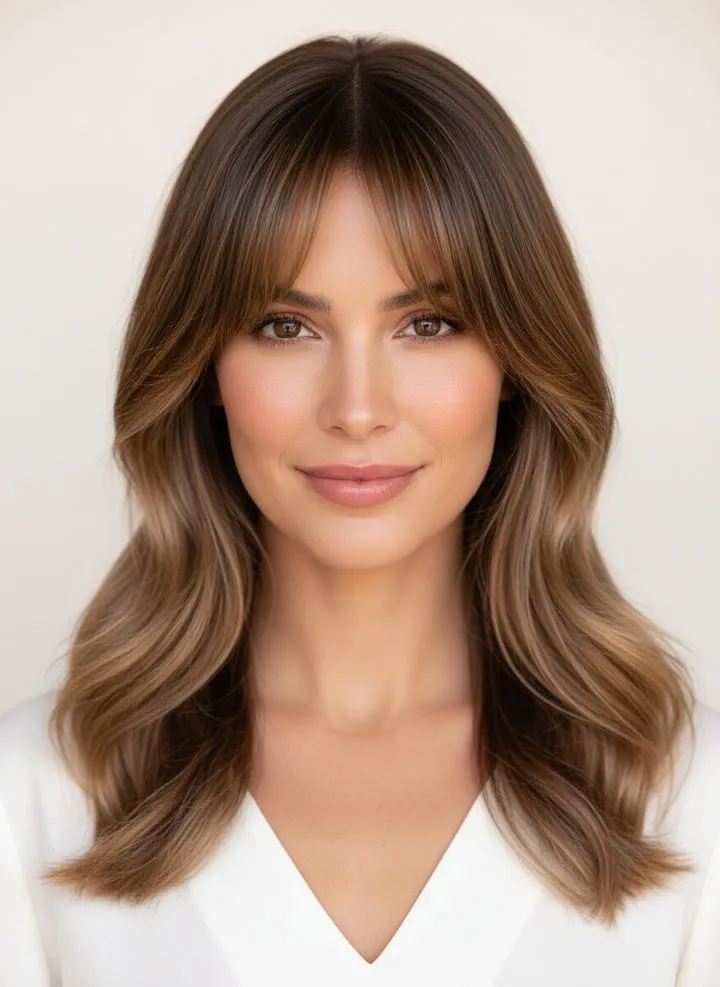
Try curtain bangs on your face →
Keep the fringe airy and longer at the outer edges. Cheekbone-grazing curtain bangs blend easily into face-framing layers and grow out gracefully. If your hair is curly, the same principle applies: ask for a parted curly fringe with enough length to account for shrinkage.
4. A deep side part with long waves
A deep side part introduces asymmetry, which breaks up the even width of a round face. Add loose waves that begin below the cheekbones and the eye follows a diagonal line across the forehead, then downward through the lengths.
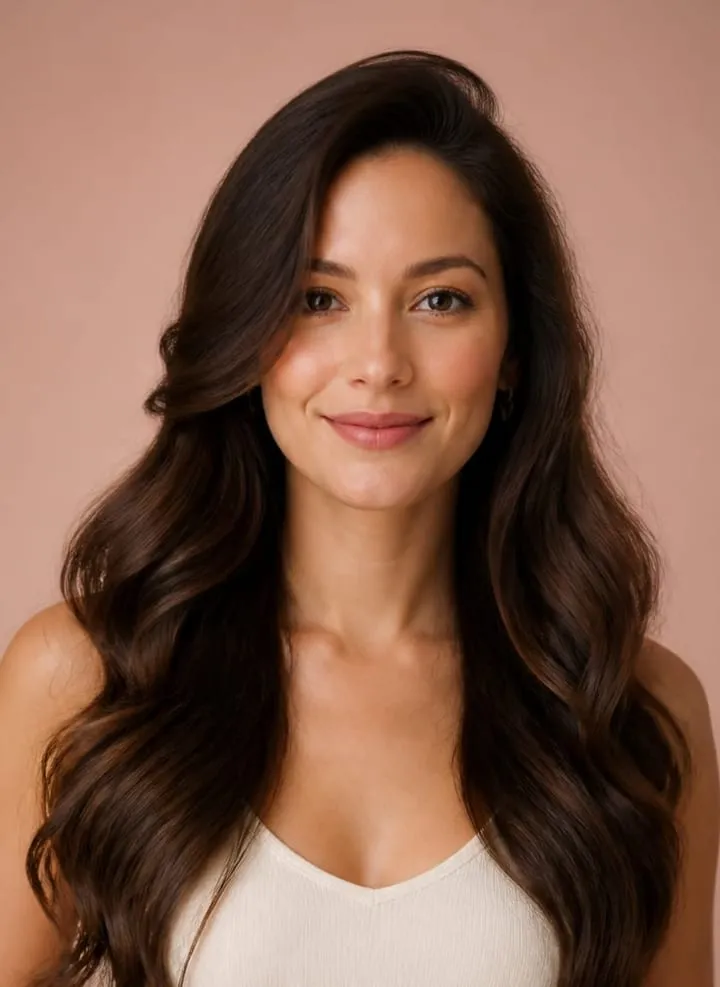
Try deep side-part waves on your face →
Keep the crown lightly lifted and avoid making the waves widest directly beside the cheeks. If your hair naturally falls flat at the roots, a small amount of root mousse or a few minutes with a large roller at the part can create lift without stiff teasing.
5. A textured pixie with height
Short hair does not make a round face look rounder by default. A textured pixie works when it has height at the crown, movement through the top, and slightly neater sides. A long side-swept fringe adds another useful diagonal and gives you styling flexibility.
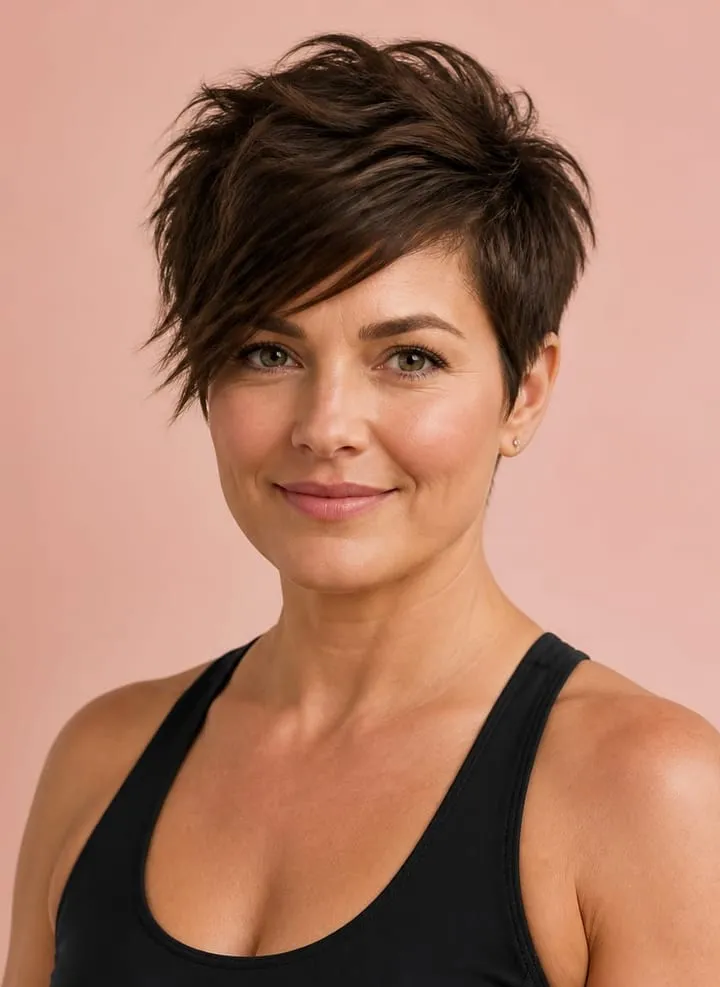
Try a textured pixie on your face →
The cut to ask for is not a uniformly round crop. Request tapered sides and nape, longer texture on top, and a fringe that can sweep across rather than sit straight down. A long pixie or soft bixie cut is a lower-commitment version if you are not ready for a close crop.
6. A collarbone shag or wolf cut
A modern shag builds separated, piecey movement instead of a solid outline. On a round face, the most flattering version has lift near the crown, face-framing pieces that travel past the cheekbones, and length at the nape. The broken vertical texture adds definition while still feeling relaxed.
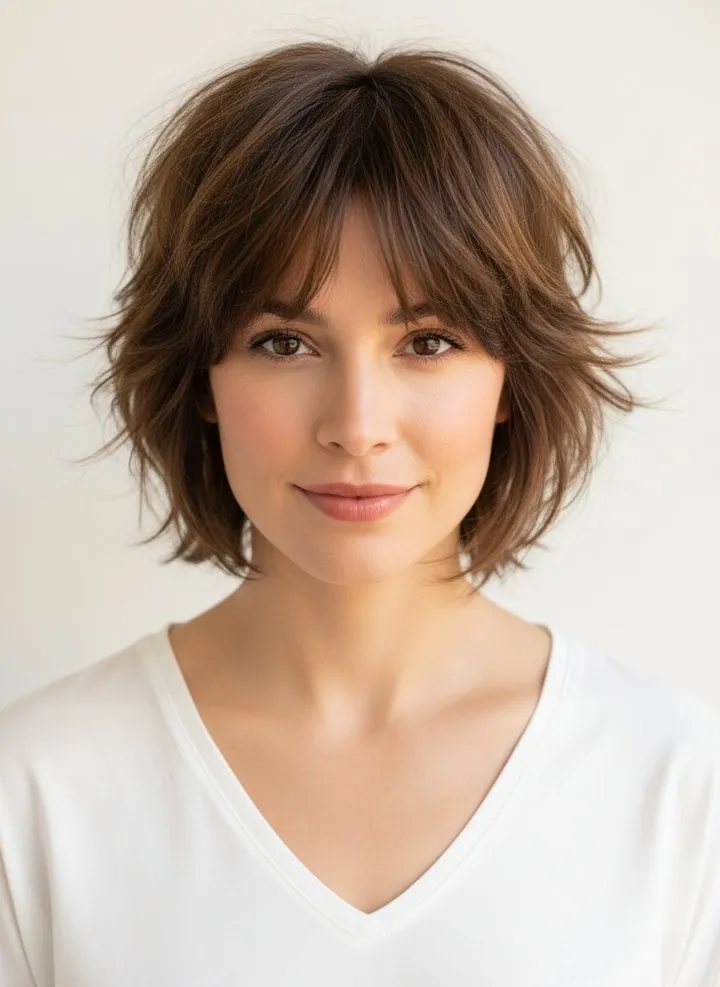
Try a collarbone shag on your face →
For thick or wavy hair, a modern shag removes weight without flattening your natural movement. A softer wolf cut gives a similar effect with more contrast between the top layers and the length. Ask your stylist to avoid placing the widest layer exactly at mid-cheek.
7. A sleek long bob with an off-center part
If you prefer clean lines, choose a one-length or softly graduated bob that falls below the chin. The uninterrupted length creates a vertical frame, while an off-center part prevents the style from mirroring the face too precisely.
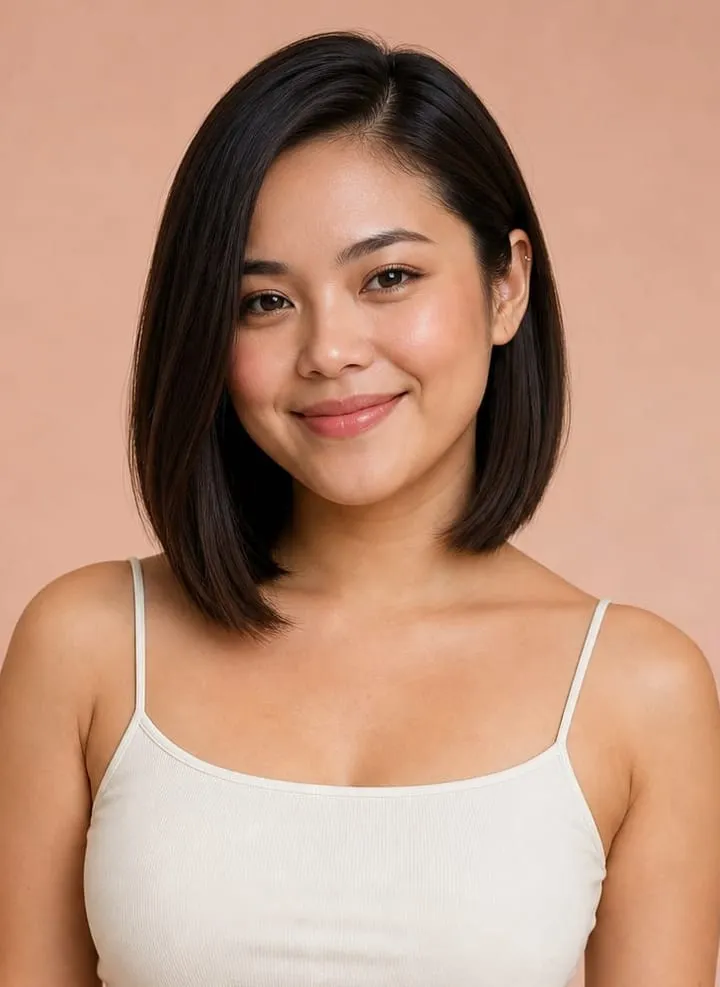
Try a sleek long bob on your face →
This cut is particularly effective on fine or straight hair because the blunt perimeter makes the ends look fuller. Tuck only one side behind the ear or add a slight bend below the jaw for asymmetry. The key is where the line ends: below the chin lengthens; directly at the cheek often widens.
8. A high ponytail or top knot
You do not need a new haircut to use the same proportion trick. A high ponytail, high bun, or top knot draws attention upward and adds visible height. Keep a little softness at the crown and, if you like, leave two long face-framing pieces loose.
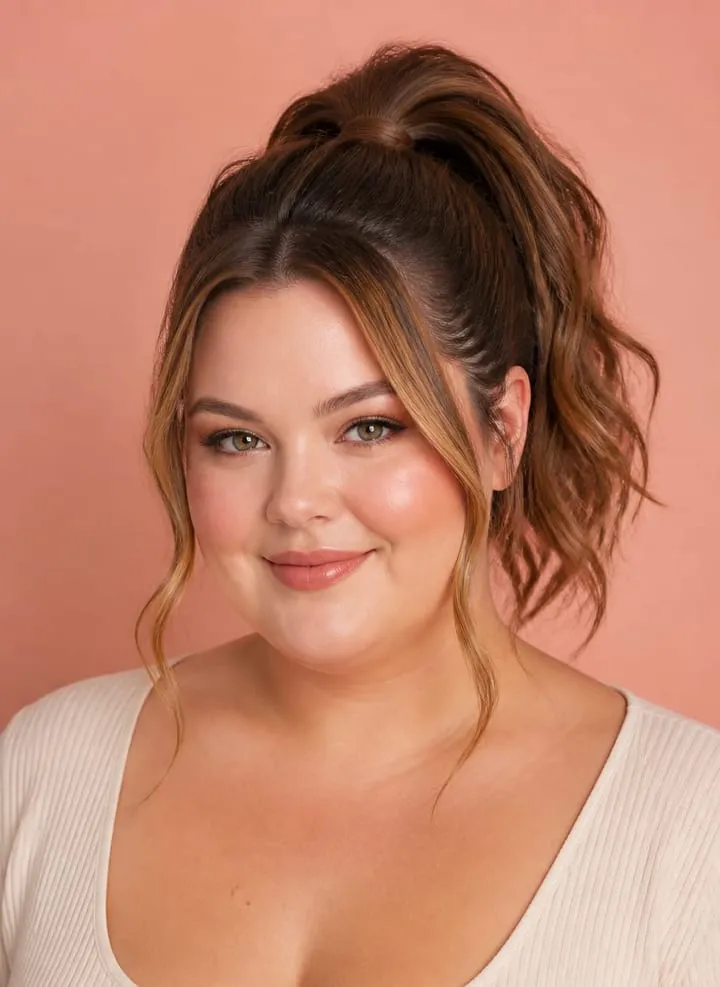
Try a high ponytail on your face →
For a polished result, place the ponytail above the occipital bone rather than straight back at ear level. A low, wide bun can add fullness near the jaw; a higher placement shifts that volume to a more lengthening position.
The best styles by hair length
Short hairstyles for round faces
Choose a textured pixie, long pixie, asymmetric bixie, or angled bob. Look for height at the top, a side-swept fringe, or a front section that falls below the chin. Keeping the sides tapered prevents the cut from forming a circular outline.
Medium hairstyles for round faces
Collarbone lobs, shoulder-length shags, and medium cuts with face-framing layers are the sweet spot. They are long enough to create vertical lines but short enough to hold lift and movement. Begin layers below the fullest part of the cheeks for the clearest lengthening effect.
Long hairstyles for round faces
Long hair flatters a round face when it has movement. Add long layers, a center or deep side part, and tapered face-framing pieces. Very long hair that is completely flat at the crown can drag the face downward, so keep a little root lift and shape through the ends.
What works for curls, coils, and thick hair?
Round-face advice often assumes straight hair, but the same placement principles work across textures. Curly and coily hair can be worn big; the goal is simply to choose where the silhouette expands.
- Curly hair: Ask for a rounded-vertical shape with lift at the crown and length below the jaw. Long curly layers prevent one heavy shelf of volume at the cheeks.
- Coily hair: A tapered cut with height, a high puff, a shaped Afro with more height than side width, or long layered coils can all create a striking, balanced outline.
- Thick hair: Internal layers remove bulk without producing short pieces that spring outward at cheek level. Ask the stylist to preserve length around the perimeter.
- Fine hair: A blunt lob below the chin keeps the ends dense. Use subtle face-framing rather than too many layers, which can make fine hair look sparse.
Hair texture should lead the decision. A flattering cut that demands a daily blowout you will never do is not your best cut.
For more options organized by density, perimeter, and styling effort, explore our guide to the best haircuts for fine hair.
Bangs for round faces: what actually works?
The best bangs for round faces show some forehead or create a diagonal: long curtain bangs, side-swept bangs, and wispy separated fringe. They interrupt width without closing off the top half of the face.
A thick, straight-across fringe tends to make the face appear shorter because it creates a horizontal line and hides the forehead. That does not make it forbidden. If you love blunt bangs, ask for a slightly curved, lighter version with longer edges, or pair the fringe with length and crown volume so the overall cut still feels balanced.
Haircuts to approach carefully
No haircut is universally off-limits, but these shapes emphasize roundness rather than counterbalancing it:
- A blunt bob ending at the widest part of the cheeks
- A heavy straight-across fringe with no separation
- A chin-length cut with equal volume on both sides
- Short, rounded layers that stack outward at cheek level
- Flat roots paired with very wide curls at the sides
If one of those is your favorite look, wear it. The distinction is simply that it will echo the face’s curves rather than create a longer or more angular effect.
What to ask your hairstylist for
Bring reference photos that match your hair texture and say where you want the visual weight to sit. A useful salon request is:
“I want a shape that adds a little height and keeps the sides from getting widest at my cheeks. Please start the face-framing pieces around my cheekbones or jaw, keep the main length below my chin, and show me how to style the part with my natural texture.”
Also tell the stylist how often you heat-style, how much time you spend on your hair, and how frequently you will return for trims. Those facts determine whether your best version is a sharp angled lob, low-maintenance long layers, or a textured short cut.
Try the cut on your face before the salon
A face-shape guideline can narrow the options, but it cannot account for your hairline, features, neck length, or personal style. The fastest way to compare the final two or three choices is to see them on your own photo.
Get The Look lets you preview hairstyles on a selfie while keeping your facial features recognizable. Try one safe option and one you would normally rule out—you may find that the pixie is stronger than the long layers, or that an angled lob needs only a different part. Our guide to trying hairstyles on your own face walks through how to take a useful photo and compare results.
The bottom line: long face-framing layers are the most versatile hairstyle for a round face, an angled lob is the strongest medium-length option, and a crown-lifted pixie is the best short choice. Favor vertical movement, diagonal lines, and intentional volume placement, then adapt the cut to your texture and the way you actually live.
FAQs
- What hairstyle is most flattering for a round face?
- Long face-framing layers are the most versatile choice for a round face. Keep the overall length below the chin, start the shortest pieces around the cheekbones or jaw, and add a center or deep side part. Those vertical and diagonal lines make the face look longer without hiding it.
- Does short hair look good on a round face?
- Yes. A round face can wear short hair beautifully when the cut has height or asymmetry. A textured pixie with volume at the crown, an angled bob that falls below the chin, or a side-parted bixie creates definition. Avoid building the widest volume directly at the cheeks if your goal is a longer-looking silhouette.
- Are bangs good for round faces?
- Curtain bangs, long side-swept bangs, and light wispy fringe suit round faces because they create diagonal or separated lines. Keep curtain bangs long enough to open around the cheekbones. A thick, blunt fringe can visually shorten the face, although it still works if that is the look you want.
- Should a round face have a middle or side part?
- Both can work. A middle part creates two clean vertical lines and looks especially good with long layers. A deep side part adds asymmetry and lift, which can make the face look more defined. Choose the one that works with your natural growth pattern and the cut.
- What hair length makes a round face look slimmer?
- Hair that falls below the chin—especially collarbone length or longer—usually creates the strongest lengthening effect. The exact length matters less than the shape: vertical layers, tapered ends, and volume above or below the cheeks are more flattering than a wide, one-length shape ending at the fullest part of the face.